Wednesday, November 30, 2016

All the turkey is et

Due to guests' schedules, this year at the Blue Door, Thanksgiving dinner was served on Friday.   I roasted one of Diestel Farm's Organic Heirloom turkeys, a smallish bird weighing in at 13 pounds.  I was very pleased with it.  I applaud breeders for making the effort to breed good turkey flavor back into turkeys and I like to support their effort by buying these more expensive birds.

Even though I have fresh herbs in my garden, I still use Bell's Poetry Seasoning* in my dressing.


I recommend that you get a box, and get into the habit of roasting a whole chicken periodically, maybe for the traditional Sunday dinner, which gives you great left-overs for Monday lunch or dinner.  Consider it training for the annual turkey.

*It's actually Bell's Poultry Seasoning, but a grocery clerk mis-heard my request for it in the store once and asked his supervisor if they carried Bell's Poetry Seasoning.  I just love the idea of poetry seasoning.

Thursday, November 17, 2016

Learning to be cloth

Cloth as it comes from the loom is referred to as "gray goods" or "greige."  I think of it as proto-cloth - a coalition of warp and weft threads that haven't yet realized that they're part of something bigger.  For the cloth that I weave, the transition from gray goods to finished cloth starts with washing.

I take a fairly old-fashioned approach to washing my gray goods:  lots of water, lots of soap, and a little agitation (of the cloth, not me - I actually find the process quite relaxing.)

And when I say "soap," I mean real soap, not detergent.  Try to think back to your high school chemistry class - I'm sure this topic was covered there.  Real soap flakes can be hard to find, so for years I made soap and shaved flakes with a cheese grater.  Recently I've found that I can buy Zote brand soap flakes locally, so I'm giving them a try.  For a bath tub of hot water, I use about a cup of soap flakes that has been dissolved in a quart or two of water.

Here's recent warp of wool and cotton blankets in the wash water.  Don't see the blankets?  That's because the soap has done a good job of binding to the various waxes and spinning oils from the yarns and holding them in suspension.


Here's the first rinse water.

And here's the second rinse water - that's more like it!

In the time line between banging cloth on stones by the stream's edge and the modern domestic washing machine, many laundry aids were invented.  Most people have at least a passing acquaintance with washboards, but the aerating washer is far less well known.

Tin plated washers are still available, but I decided to go with a non-rusting plastic version.
From Mobile Washer
I really admire the Mobile Washer folks for their commitment to this piece of appropriate technology.  And isn't that a great shade of blue?

I bought my washer without a handle and then attached a standard broom handle so that I can stand while agitating the blankets in the tub.  I use it in both the wash and the rinse waters.

The Promise of Spring


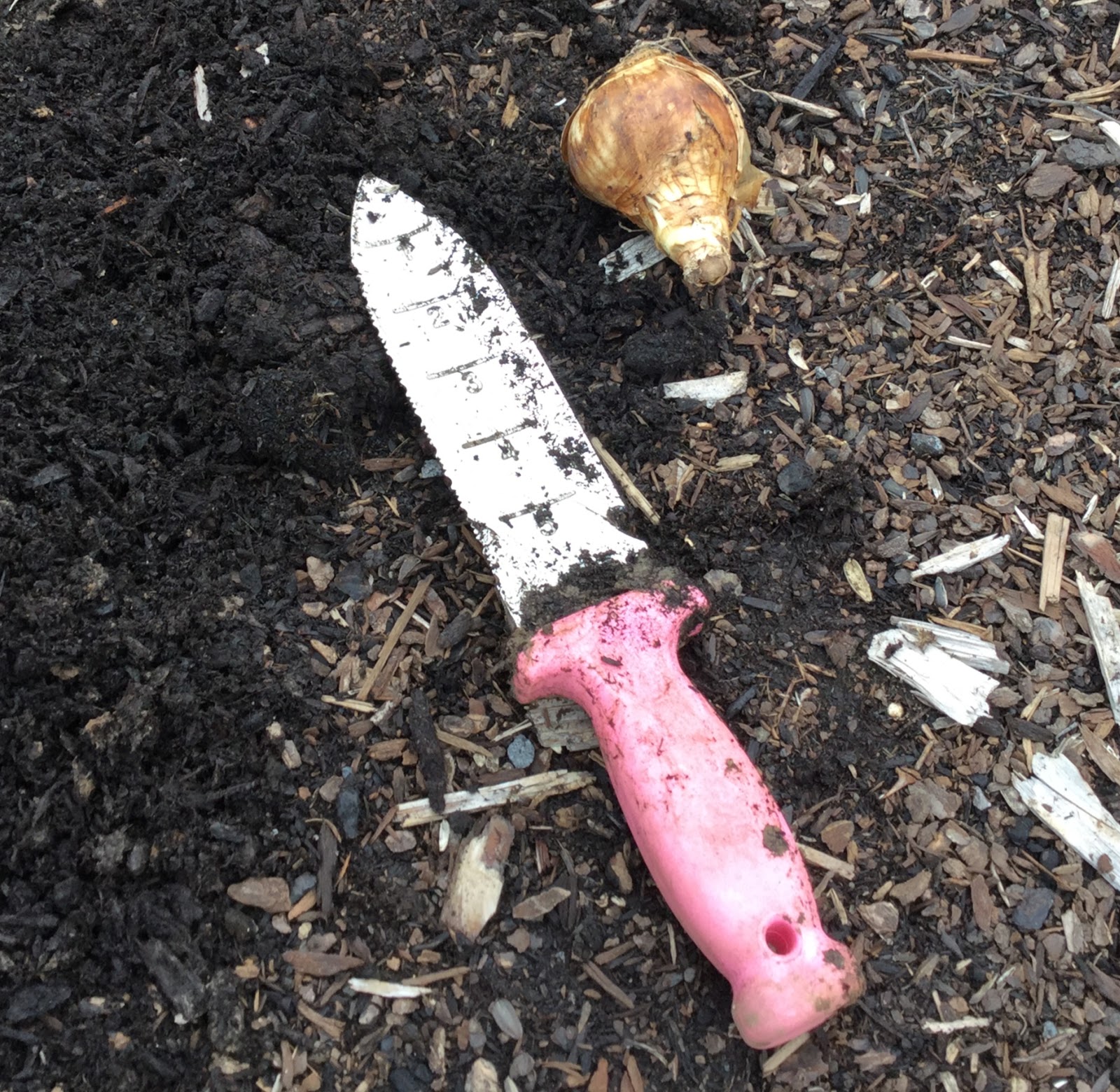
The bulbs that I ordered in August arrived last week.  I don't remember whether I specified this late planting date or the vendor decided it on their own.  I was lucky to have a dry day on which to dig holes in Awful Heavy Clay to get them planted.  I amended the soil with compost I'd harvested over the summer and a little bulb food.


By the end of the afternoon I'd planted 75 grape hyacinth bulbs and 30 daffodil bulbs, about my limit for one day's work.   The weather gods then smiled on my efforts by providing some very nice showers to get the bulbs watered in.

Wednesday, September 21, 2016

Sampling

Sampling is the part of the design phase in which I learn the characteristics of the yarn I want to use.  This is Jaggerspun 2/20 Maine Line, in Bittersweet, Natural, and Williamsburg Blue, set at 32, 36 and 40 ends per inch.  Twill and tabby each behave differently, and the very slightly sticky shed is something I'll need to get used to.   The hand of the twill at 40 epi is really lovely.

Friday, September 16, 2016

The Primitive Smock

Recently I decided to make a smock, based (loosely) on the modern fisherman's smock, which seems to survive today primarily in Cornwall and Brittany; the Norfolk slop; and smocks that show up now and again in nineteenth century photographs.

I adapted the techniques I'd previously used for making an eighteenth century shirt.  The smock is cut entirely of squares and rectangles.  Some of the squares are folded in half and used as triangles.  I used some linen that had been in my stash for about 10 years.

The most interesting feature of these smocks is that there is no front opening.  This makes the smock faster to make up and is a better functional choice if the goal is to keep out sea spray, dust, chaff, and the like.

I guessed, mostly right, on the size for the neck opening.  Quite a bit of arithmetic was involved to account for the amount that the neck gusset added to the neck circumference.  The next time I make up the smock, I'll make the neck opening about an inch smaller.

I didn't make the side vents deep enough, which means that I have to hike up the smock a bit if I want to put my hands in my pockets.

Seams and hems were sewn by machine.  The sleeve and body seams were flat-felled by hand.
Neck gusset and collar band

Sleeve gusset
The hip gussets were sewn in by hand.
Hip gusset at the left
Marked so that everybody knows it's mine


Sunday, August 7, 2016

Summer weight blankets


This being summer, I decided to use up some mill end yarns I bought years ago to weave light-weight blankets.  These are woven of cotton and wool.  This type of blanket is typical of farmhouse production in the early to mid-nineteenth century.  Commercially spun cotton became available in the mid 1790s.

Home looms typically accommodated widths no greater than about 45 inches, so blankets and sheets were made up of multiple widths that were then seamed together.  The loom I'm using for the blankets will weave 36 inches wide.

Once taken off the loom and washed in plenty of soap suds and hot water, the blankets were cut and the edges of two widths were loosely whipped together, then opened out. and pressed.  This is the wrong side.

This is the right side after pressing.


Saturday, April 30, 2016

Weaving again


A nice easy warp of kitchen towels. 10/2 perle cotton.